
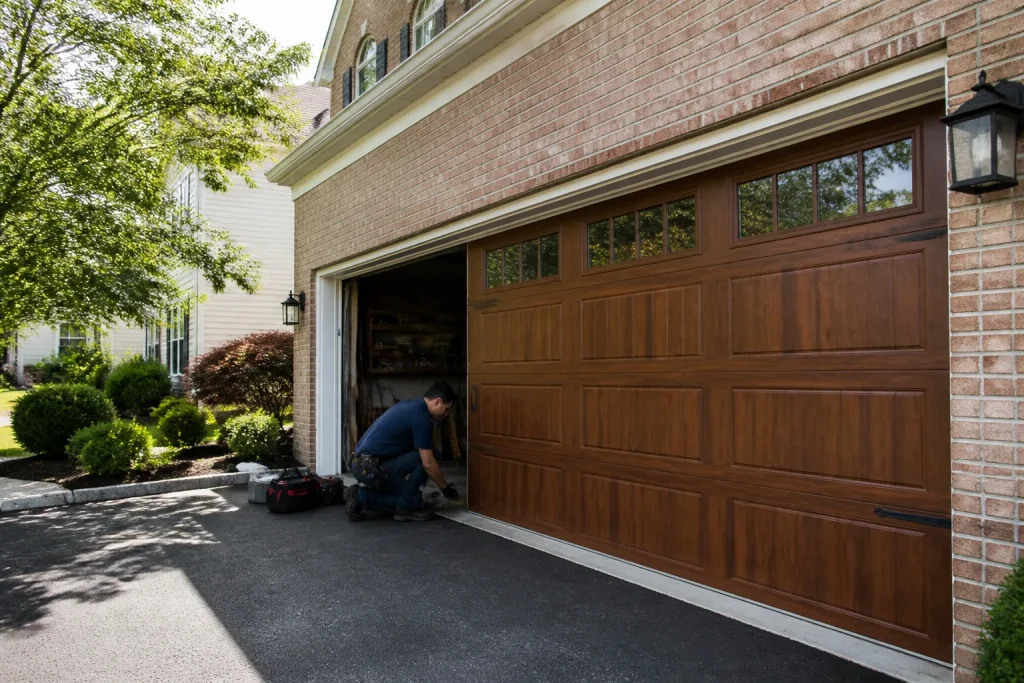
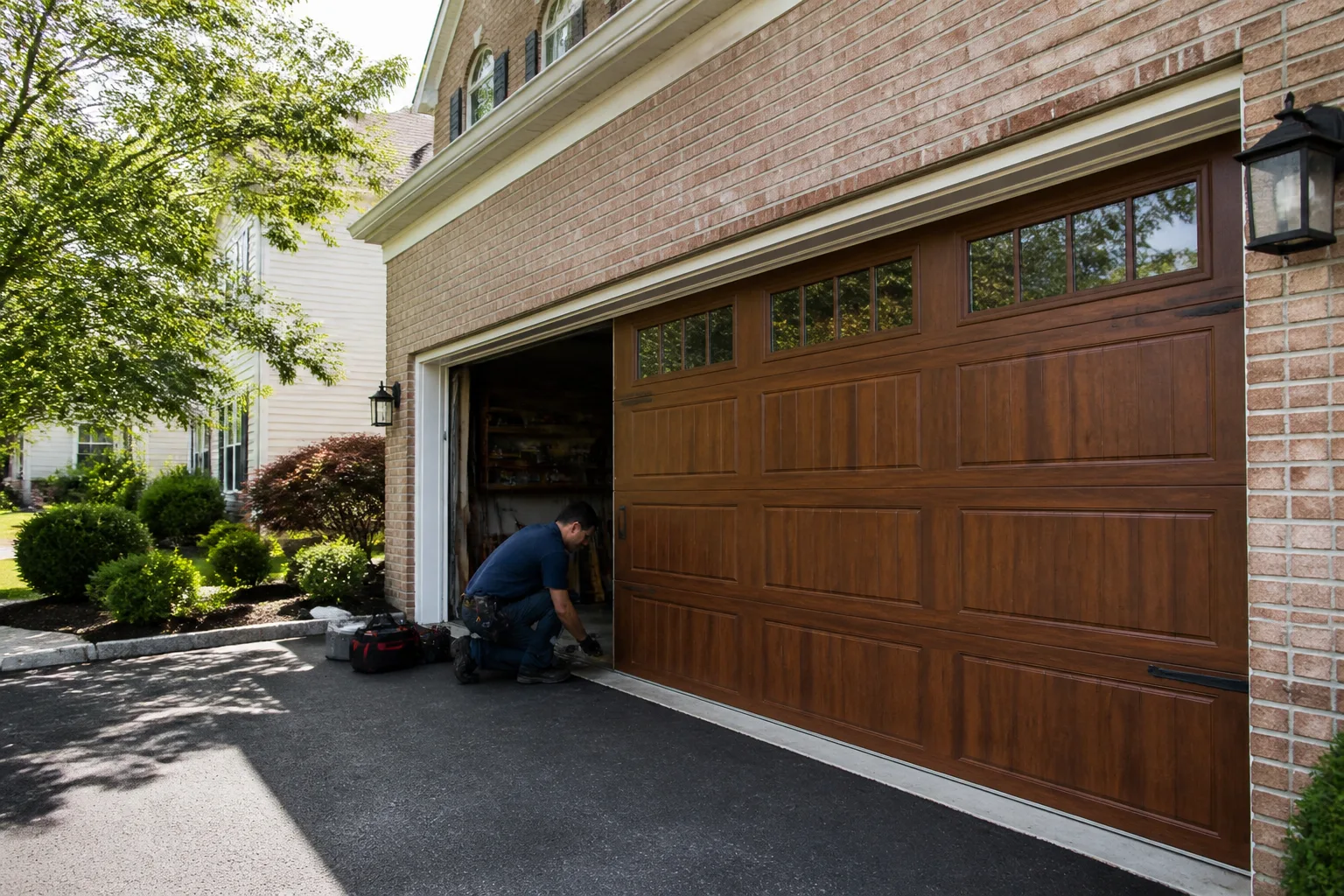
Raynor Garage Door Repair in Hackensack: A Homeowner’s Guide
If your Raynor door is failing, the repair usually comes down to three things: a worn spring, tired rollers or a seal that has given out – and the fix depends on which Raynor series you own. Raynor has built doors since 1944 and sells through dealers, not big-box stores, so the door on your Hackensack home was likely installed by a builder or a previous owner, and you may know almost nothing about the model you’re maintaining. That knowledge gap is where misdiagnosis starts. This guide decodes the naming, the hardware and the failure points so you can have an informed conversation with any technician. If you’d rather skip the detective work, call (844) 959-3216.
How do you identify your Raynor model in Hackensack?
You identify a Raynor door by the manufacturer’s sticker, usually placed on the inside face of the top or bottom panel or on the vertical steel stile near a hinge. Read the model series off that label before you call anyone, because it tells a technician what spring sizing and hardware the door was built around. Raynor sells through a dealer network, so the label is often the only paper trail left on an older Hackensack door.
What the series tells you:
- Heritage series – a long-running line of insulated and non-insulated steel doors. Many were installed on homes built or renovated in the 1990s and 2000s. Expect to see original springs at or near the end of their service life, and bottom seals that have hardened.
- Aviator series – a more recent carriage-style and full-view line. Rollers and hinge wear show up on these before springs do, especially where a door cycles several times a day.
- Commercial and heavier gauge panels – when a builder spec’d a thicker insulated panel on a residential home, hinge stress becomes the weak point because the door is heavier than a standard panel of the same width.
Write down the model number, the door width and height, and whether the door has one spring or a pair of torsion springs above the header. That single note saves time on every future call.
What are the most common Raynor failure points by door age?
Raynor doors fail in predictable order as they age: bottom seal first, rollers next, then hinge stress on heavier panels, and springs somewhere along the way. In our experience, homeowners in Hackensack often replace parts out of sequence – a new opener gets blamed for what is actually a dragging door. Here’s how it usually goes:
- Bottom seal degradation on older Heritage doors. The rubber weather seal flattens and cracks, letting water, road grit and cold air under the door. A stiff seal also makes the door drag on the frame, which pulls extra current through the opener.
- Roller wear on Aviator models. Nylon rollers develop flat spots and the door starts to rumble or hang on one side. Worn rollers put lateral strain on the tracks.
- Hinge stress on heavier insulated panels. Insulated panels weigh more. Hinges and their fasteners carry that load, and the bottom hinge of a heavy door takes the most punishment.
- Spring fatigue. Torsion springs are rated in cycles, not years. A door used several times a day will wear out its springs long before the panels wear out.
One thing we tell every owner: a Raynor panel outlasts most of the hardware bolted to it. If the panels are straight and the finish is sound, a hardware refresh is usually the better call than a new door.
Why do Raynor doors need specific weatherstripping and bottom seals?
Raynor’s bottom seal and weatherstripping profiles are proprietary, so a generic seal forced into the retainer often won’t sit flat, and that’s when drafts and water intrusion start. The seal isn’t a universal strip of rubber. It’s shaped to fit the specific aluminum retainer on your door’s bottom section, and the profile varies between series.
What happens when a generic part is forced in:
- The seal seats unevenly, leaving gaps at the corners where cold air and water get in.
- The door doesn’t close flush, so the opener’s travel limits are set around a bad seal instead of a correct one.
- Rubber that’s the wrong durometer (too hard) won’t compress, so the door bangs on the floor and the operator’s safety reverse may trip.
- Over time, a poor seal lets grit collect along the threshold, which wears the bottom panel’s finish.
Ask any technician to confirm your door’s series before they order a seal, and to check the retainer for bends while they’re at it. A seal that fits right is a two-minute job to appreciate. A seal that doesn’t is a slow leak you’ll notice in January.
How do Raynor doors work with LiftMaster and Chamberlain openers?
Raynor doors work fine with LiftMaster and Chamberlain openers – the two most common openers in Hackensack homes – as long as the door’s bracket and balance are set correctly. The opener doesn’t care about the brand stamped on the panels; it cares about how much force it takes to move the door. When a Raynor door feels heavy, the opener gets blamed for a door problem.
Bracket and balance issues to watch for:
- Header bracket and door bracket alignment. The opener’s rail and the door bracket need to be aligned so the arm doesn’t bind as the door travels up. On a heavier insulated Raynor panel, a bracket bolted to a single stile can flex.
- Spring balance first, opener second. If the door is out of balance – it drifts down when lifted halfway – the opener is working overtime to compensate. That’s a spring or cable problem, not an opener problem.
- Force settings. A properly balanced Raynor door moves easily by hand. A technician should set the opener’s force limits to a balanced door, not crank them up to overcome a dragging one.
- Smart openers. Modern LiftMaster and Chamberlain units with Wi-Fi and battery backup still need the same mechanical setup. Connectivity doesn’t fix a bad bracket.
If your LiftMaster won’t respond or your Chamberlain keeps reversing, the first check is the door’s balance and the safety sensors – not the Wi-Fi. Our garage door opener repair service covers both smart and legacy systems.
What should a Raynor-specific service call include?
A Raynor-specific service call should include a model check, a spring balance test, a seal and retainer inspection, and a roller and hinge check – not just a squirt of lubricant on the tracks. A generic tune-up skips the model identification, and on a Raynor that’s where the useful information lives.
What a proper call to a Hackensack home includes:
- Model and series identification from the sticker, so the right spring size and hardware are ordered the first time.
- A balance test. The door is lifted halfway by hand to check for drift, which tells the technician whether the springs are doing their job.
- A seal and retainer inspection for a correct-fit bottom seal, not a generic strip.
- Roller and hinge check for flat spots, loose fasteners and stress cracks on heavier panels.
- Opener force and travel check so the operator is set to the door, not the other way around.
Springs and cables are high-tension parts. We don’t hand out step-by-step instructions for those, and neither should anyone else – a torsion spring under load can cause serious injury, and the safe move is to have it handled by a trained technician. Our garage door spring repair is done as a core service, not an add-on, and the local pro is licensed and insured as their state requires.
When the panels themselves are the problem – dents, rot in a wood-frame model, or a door that’s been patched one time too many – a full replacement makes more sense than chasing hardware. Our garage door repair covers the fix, and installation covers the rest.
When should you call a pro instead of troubleshooting?
Call a pro when the door won’t stay up, the springs look stretched or broken, the cables are frayed, or the door has come off a track. Those are the situations where a Raynor owner is most likely to make it worse by forcing the door. A door that reverses, binds or hangs is a symptom, and the cause behind it – spring tension, bracket alignment, roller wear – needs tools and training to diagnose safely.
If the door is simply noisy or one panel is scuffed, that’s a conversation, not a crisis. We’re happy to tell you that over the phone. And if the door fails on a Saturday, we’re closed that day – call and we’ll book you for Sunday. We answer 24/7. Fast dispatch from 7am to 7pm, Sunday through Friday.
For help beyond Raynor, our Hackensack Garage Door Repair Pros page collects the full picture, and our Hackensack Garage Door Repair Pros team covers Amarr, Wayne Dalton, Craftsman and every other major residential brand – so you’re not calling around to find a “Raynor tech.”
The Bottom Line
Your Raynor door is probably sturdier than the hardware bolted to it, and the model sticker on the inside panel is the key to fixing it right. Identify the series, note the spring configuration, and expect the bottom seal, rollers and hinges to wear before the panels do. If you’re in Hackensack and need help, Hackensack Garage Door Repair Pros offers free estimates – call (844) 959-3216.
Frequently Asked Questions
Most Raynor repairs fall into a predictable range depending on what’s failed – a spring job, a roller and hinge refresh, a bottom seal replacement or an opener repair. We don’t publish a single number because the written estimate sets the final price, and it’s free. The range is quoted and agreed before any work starts, so there are no surprises on the invoice. Call (844) 959-3216 for an exact quote.
Yes, most Raynor repairs – a broken spring, a dragging door, an opener that won’t respond – can be handled the same day when the part is in stock. Emergency garage door service is part of our core offering, not an exception. Call (844) 959-3216. We answer 24/7. Fast dispatch from 7am to 7pm, Sunday through Friday.
No. The price is quoted and agreed before any work starts. If we find something that changes the job – a bent track or a bracket that needs replacing – we tell you first and re-quote before touching anything. The written estimate is the price you pay.
The local pro we connect you with is licensed and insured as their state requires. Our technicians have up to 12 years of experience across the major residential brands, including Raynor, LiftMaster, Chamberlain, Genie, Clopay, Amarr, Wayne Dalton and Craftsman. Call (844) 959-3216 for a free estimate.
Written by the team at Hackensack Garage Door Repair Pros.
Need Garage Door Help?
Call Hackensack Garage Door Repair Pros - the local pro we connect you with is licensed and insured, here with fast help in Hackensack.
(844) 959-3216