
Top Signs You Need Garage Door Service – Don’t Ignore These
The clearest signs you need garage door service are a door that opens slower than it used to, a grinding or scraping sound, a sagging section, a door that reverses before closing, or a spring that looks stretched or frayed. Each of these points to a specific part wearing out, and catching it early is what keeps a small repair from turning into a snapped cable or a dropped door. If you’d rather not crawl around the tracks yourself, call (844) 959-3216. We answer 24/7.
A garage door that takes two seconds longer to open than it did six months ago isn’t “getting old.” It’s telling you the spring tension is off, and a torsion spring running below its rated load wears faster and fails more violently than one doing its job correctly. That’s the thing most homeowners miss: the symptom on the surface is rarely where the problem lives. So instead of handing you a generic checklist, we want to explain the mechanical cause behind each warning sign. When you understand what’s actually degrading, you can judge urgency for yourself. That’s how you decide whether to book a same-day visit or watch a part for another month.
Why Is Your Door Suddenly Slower or Heavier?
A door that feels heavier or moves sluggishly usually means the springs have lost tension, not that the opener is weak. Torsion and extension springs counterbalance the door’s weight. As they relax, the opener has to haul more of that weight itself, and you feel it in the lag.
Springs are rated for a specific number of cycles, and a cycle is one open plus one close. A worn spring that’s still working is running outside its design load, which is exactly when it’s most likely to snap. That failure doesn’t announce itself politely. The force stored in a wound torsion spring is serious, which is why spring work is one of the few repairs we tell people never to attempt themselves. A trained technician with the right winding bars and the right replacement is the safe path. Our team handles spring repair as a core service, and our technicians have up to 12 years of experience reading exactly this kind of wear.
If the door is slower and the springs look fine, the opener may be straining against a binding track or a dry roller. Either way, the cause matters more than the symptom. A sluggish door is your chance to schedule a repair on your terms.
What Does That Grinding or Scraping Sound Actually Mean?
Grinding almost always comes from rollers or hinge bearings, not the opener motor. The metal rollers ride in the track and pivot at each hinge; when their bearings dry out or the roller wears flat, steel grinds against steel on every pass.
It’s tempting to blame the motor because that’s the part making noise you recognize. But a motor problem usually sounds like a hum, a click, or nothing at all, while a mechanical problem gives you that gritty scrape. Here’s how to tell them apart:
- Grinding that follows the door’s travel: rollers, hinges, or track alignment.
- A single pop or clunk at one spot: a worn hinge or a loose panel fastener.
- A hum with no movement: opener drive or gear problem.
- Rattle on close: loose hardware or a track that’s worked out of alignment.
Ignoring a grind is how a $10 roller turns into worn hinges and a chewed-up track. In Hackensack, a door that sits through cold winters and humid summers cycles through plenty of expansion and contraction, and that works lubricant out of bearings faster than a steady climate would. If your LiftMaster or Chamberlain opener is straining to push a door that grinds, the motor is a bystander, not the culprit.
How Do You Run the 30-Second Balance Test?
Pull the release cord to disconnect the opener, then lift the door to about halfway and let go. A healthy door holds its position. A door that drifts down on its own has springs that have lost tension and is telling you a failure is coming.
This is the single most useful check a homeowner can run, and it takes half a minute. Do it with the door disconnected from the opener so you’re testing the springs and the door’s own balance, not the motor. If it sags toward the floor, the springs aren’t holding their share of the weight.
Run the same test in a couple of positions. A door that holds at halfway but drops near the top or bottom can point to a spring that’s partially failed or a cable that’s gone slack on one side. When a door drifts, stop using the opener and book garage door spring repair rather than waiting for the spring to finish the job on its own. Keeping a well-balanced door also protects the opener, since the motor no longer fights gravity on every cycle.
Which Symptoms Mean Stop, and Which Can Wait?
Some warning signs let you keep using the door with an appointment on the books. Others mean stop operating it now and call. The difference is whether a part failure could drop the door or throw metal.
Stop using the door immediately if you notice:
- A snapped spring, or a visible gap in a torsion spring.
- A frayed, kinked, or hanging cable.
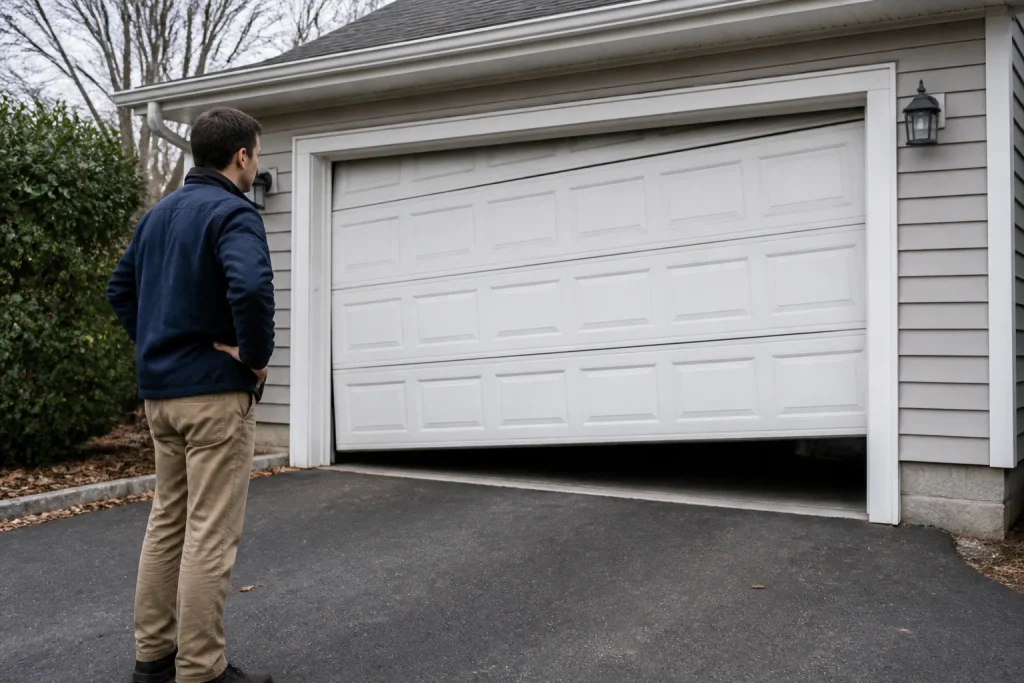
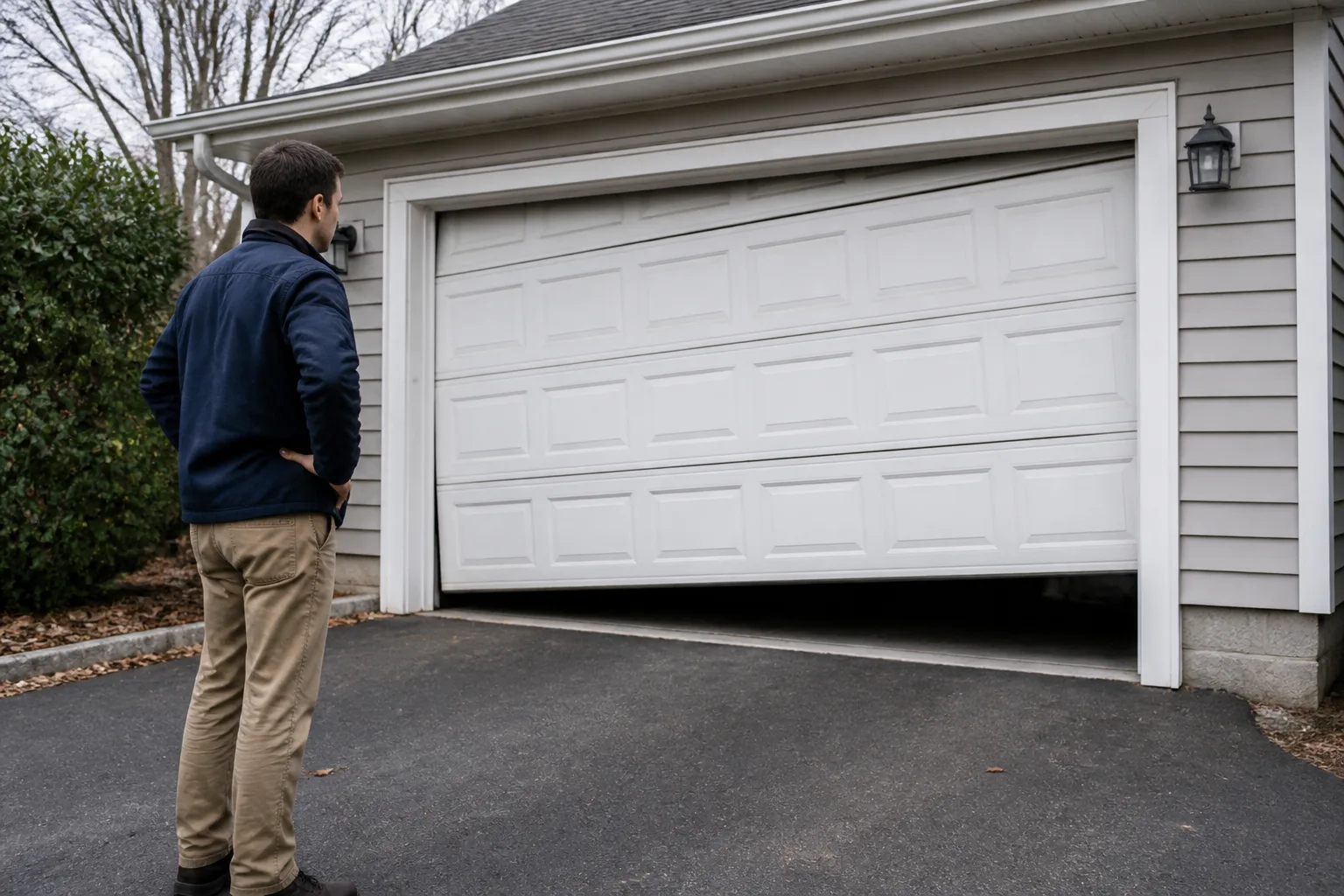
- A door hanging crooked, with one side lower than the other.
- A door that closes and then reverses on its own, or won’t stay down.
- Any loud bang followed by a door that suddenly won’t lift.
A door with a broken spring can slam down under its own weight, and a frayed cable can snap. Those aren’t “watch it for a while” situations.
You can usually schedule these for a normal visit:
- Grinding or squealing that’s gotten louder over time.
- A slow, heavy-feeling door.
- A remote or wall button that works intermittently.
- A bottom seal that’s flattened or torn.
Frayed cables and failing springs are exactly the repairs a general handyman tends to decline, and rightly so. The stored tension makes them a specialist’s job. If your Genie or Craftsman opener runs but the door hangs crooked, the opener isn’t the problem and a new one won’t fix it.
Why Does Hackensack Weather Wear Certain Parts Faster?
Hackensack swings from sub-freezing winters to humid summers, and that wide temperature range speeds up two failures in particular: cable fraying and bottom seal compression loss. Both are climate-driven, and both show up before they become emergencies.
Cables run over pulleys under constant tension. The freeze-and-thaw cycle makes the metal expand and contract, and every cycle nudges individual wire strands. Over enough winters, those strands fray and weaken from the outside in. That’s why a cable can look fine until the day it doesn’t.
The bottom seal takes the other hit. Cold hardens the rubber, and summer heat softens it back; that flexing flattens the seal against the floor over time. A compressed seal lets in drafts, water, and pests, and it throws off the door’s close. A sagging section in Hackensack is worth a closer look too, because it usually points to a failed panel joint rather than the door “settling.” Catching a worn spring at its rated cycle count costs far less than replacing a snapped spring, a bent track, and a strained opener all at once.
When to Call a Pro
If the balance test shows drift, if you hear grinding that’s getting worse, or if you see a frayed cable or a gap in a spring, that’s your signal. Springs and cables carry enough stored force to cause real injury, so this is not a job to tackle with a ladder and a socket set. Our team covers garage door repair for doors that are still hanging in there, plus garage door opener repair when the motor is genuinely the problem. We work across LiftMaster, Chamberlain, Genie, Clopay, Amarr, Wayne Dalton, Craftsman, and Raynor equipment, so the right part gets matched to your system.
Related services in Hackensack: spring repair, opener repair, and full door installation, all handled by the same team. You can start from our Hackensack Garage Door Repair Pros home page to see the full range.
The Bottom Line
The signs that matter most are the ones that reveal a cause, not just a noise. A slow door means tired springs. A grind means worn rollers. A door that drifts in the balance test means the spring is on its way out. Catch these early and you’re looking at a focused repair, not a scramble. Ignore them and a single failure can take out several parts at once. If you’re in Hackensack and need help, Hackensack Garage Door Repair Pros offers free estimates. Call (844) 959-3216. We answer 24/7, with fast dispatch from 7am to 7pm, Sunday through Friday. The price is quoted and agreed before any work starts.
Frequently Asked Questions
A door that feels heavy or drifts down on the balance test is the first sign a spring is failing. Pull the release cord, lift the door to halfway, and let go; a door that won’t hold its position has lost spring tension. Call (844) 959-3216 to book spring repair before it snaps.
Yes, if the noise is grinding without any other symptom, you can usually keep using it while you schedule a visit. Stop using it immediately if you see a frayed cable, a snapped or gapped spring, or a door hanging crooked. When in doubt, call (844) 959-3216 and describe what you’re hearing.
Grinding is usually the door’s rollers or hinge bearings, not the opener. If the door still moves but grinds on the way, the mechanical parts are worn; if the opener hums without moving the door, the drive is the issue. We repair both, so call (844) 959-3216 for a free estimate.
Once a year is a reasonable routine in Hackensack, given the sub-freezing winters and humid summers that wear cables and seals. Annual service catches a tired spring and frayed cable before they fail. Call (844) 959-3216 to set up a visit; the estimate is free.
Written by the team at Hackensack Garage Door Repair Pros.
Need Garage Door Help?
Call Hackensack Garage Door Repair Pros - the local pro we connect you with is licensed and insured, here with fast help in Hackensack.
(844) 959-3216